What buyers usually want to know about a bracelet before they source it
A bracelet may look like a small accessory, but for sourcing teams it is usually a compressed set of decisions: metal choice, finish consistency, clasp style, comfort, packaging, and how the piece will hold up after repeated wear. If the design uses a chain structure, those decisions get even tighter. A chain bracelet has to look clean on day one and still feel smooth against the wrist after a few weeks in a retail environment, which is where a lot of flashy samples quietly fall apart.
That is why buyers rarely evaluate a bracelet as “just jewelry.” They look at it as a manufactured product with a visible surface, a repetitive link structure, and a fairly unforgiving fit requirement. If the finish is off by a shade, if the link geometry is uneven, or if the terminals look sloppy, the piece can lose value fast. For product teams, the real question is not whether the bracelet looks attractive in a photo. It is whether the design can be repeated, shipped, and sold without turning into a quality headache.
What the product style suggests
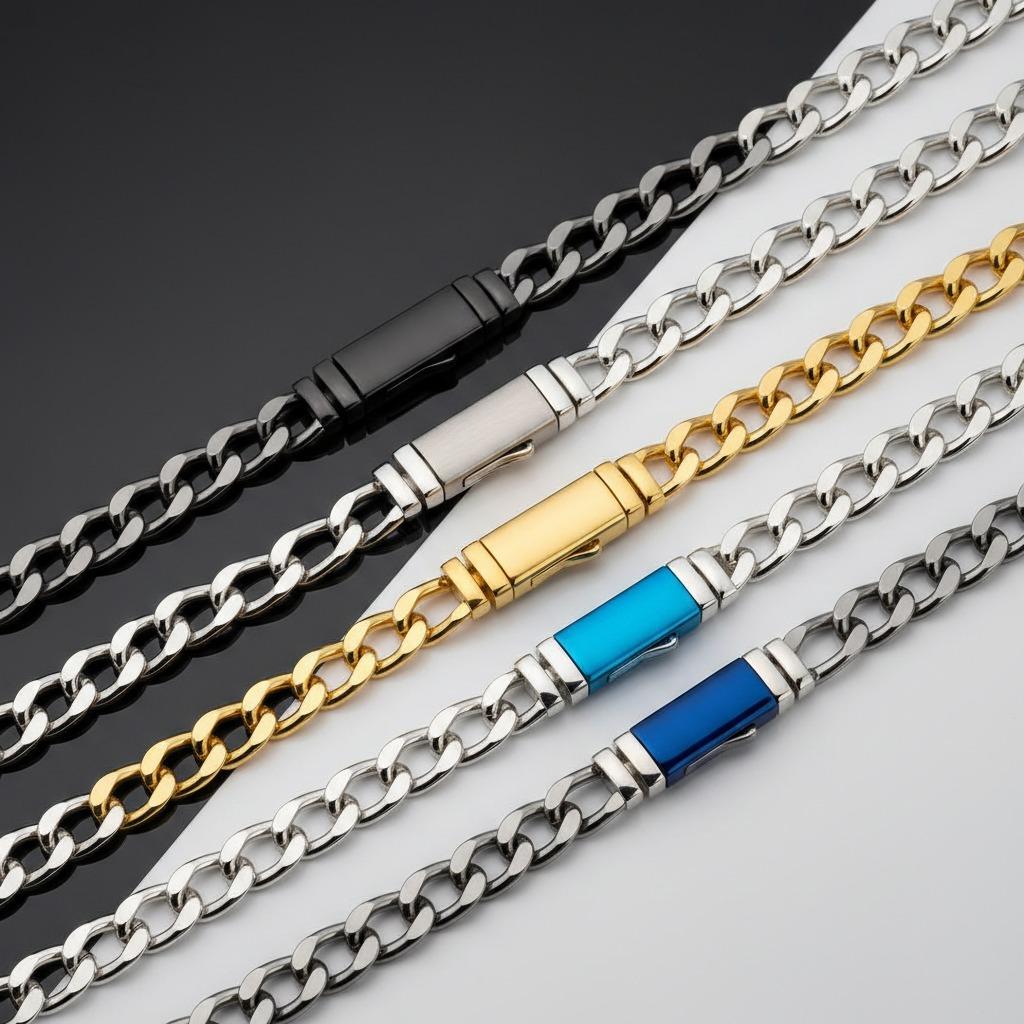
The product information points to decorative metal chain assemblies with a polished, reflective appearance and multiple color variants, including black, silver, gold-tone, and blue effects. Visually, the structure appears modular and symmetrical, with alternating rectangular and rounded links and a central elongated decorative bar or plate section. That kind of geometry is common in fashion jewelry because it gives the piece a more engineered look than a basic curb chain.
From a buyer’s standpoint, that matters for two reasons. First, the design language is strong enough to carry the product even when the material is not immediately obvious. Second, the visible repeatability of the chain pattern suggests the item is suited to batch production, which is important for OEM or ODM sourcing. If you are building a collection, a bracelet like this can serve as a standalone SKU or as part of a wider family of chain-based accessories.
A small caution: polished chain pieces can look more premium in controlled lighting than they do in everyday wear. Requesting samples in daylight, not just studio photos, is worth the trouble.
Quick reference: what to compare when evaluating a chain bracelet
Before you get lost in finishes and style names, compare the parts that affect actual sell-through.
1. Surface finish
The visual options here appear to include several metallic finishes. Buyers should check whether the finish is uniform across the links, edge corners, and connector areas. That is usually where inconsistent plating or coating shows up first.
2. Link geometry
A chain bracelet lives or dies on link consistency. If one segment looks slightly twisted or the spacing changes from one end to the other, the whole piece reads as lower quality.
3. Terminal details
The ends appear fitted with rectangular connector or clasp-like terminals. Those details matter more than many first-time buyers expect. A bracelet can have excellent mid-chain workmanship and still feel unfinished if the terminals are bulky or poorly aligned.
4. Comfort and edge feel
Metal bracelets should not scratch the wrist or catch on sleeves. Smooth edges, especially around decorative bars and link junctions, are a practical requirement, not a luxury.
Materials and finishes: what is reasonable to ask for
The product description suggests a polished metal construction, likely stainless steel or a plated alloy, but the exact base material is not confirmed. That uncertainty is common in early-stage sourcing. The safer approach is to ask the supplier to define the base metal, the surface process, and whether the appearance comes from plating, coating, anodizing, or some combination of treatments.
For a bracelet in this style, the finish often does as much selling as the underlying form. Silver-tone and gold-tone versions are obvious retail staples. Black and blue variants can help a collection feel more contemporary, but they also increase the risk of batch-to-batch color variation. Buyers should request finish samples across multiple lots if they are planning a larger program.
If the piece is meant for fashion jewelry, the finish should be judged for uniformity, edge coverage, and wear behavior rather than just shine. A bright finish that scuffs quickly is rarely a bargain.
How the manufacturing process likely breaks down
Even without exact factory details, the product points to a fairly standard chain fabrication route:
Metal components are formed into repeating link shapes.
Decorative bar or plate sections are integrated into the chain pattern.
Ends are fitted with connector or clasp-like terminals.
The surface is then polished and given its final color treatment.
That sequence sounds simple, but the control points are real. Link symmetry affects how the bracelet lays on the wrist. Assembly accuracy affects how the chain hangs. Finishing affects whether the piece feels refined or mass-produced. In a chain bracelet, all three need to work together.
A practical aside for sourcing teams: if a sample looks excellent but the ends are a little rough, do not assume that will be corrected automatically at scale. Small assembly flaws often become more visible, not less, when production ramps up.
Selection criteria for sourcing and product development
If you are evaluating a bracelet design for a private label or retail program, the decision usually comes down to a short list of questions.
Does the design fit the brand language? A heavy, industrial-looking chain bracelet can work for streetwear or contemporary accessories, but it may look out of place in a softer fashion assortment.
Can the finish be repeated reliably? Color consistency across black, silver, gold-tone, and blue versions is not a nice-to-have. It is the difference between a clean product line and a messy one.
Is the bracelet comfortable enough for everyday wear? This is easy to underestimate. A piece can photograph well and still feel awkward if the links are too rigid or the terminals sit oddly on the wrist.
Is the piece easy to merchandise? Chain bracelets with a strong visual pattern often sell better when displayed flat, looped, or paired with matching chain pieces. If your packaging or display method hides the design, you lose some of the value.
Common mistakes buyers make with bracelet sourcing
The first mistake is over-focusing on the visible center section and ignoring the end fittings. The second is treating finish color as the whole product. A bracelet that looks impressive in black may not perform the same way in gold-tone if the surface treatment is not stable.
Another common issue is forgetting that chain geometry affects wearability. Stiffer is not automatically better. A bracelet that feels too rigid may sit awkwardly and frustrate end users, especially in fashion applications where comfort drives repeat wear.
There is also a packaging problem that comes up more often than people admit. Metal bracelets can scratch each other during transit, and plated surfaces are especially vulnerable. If the supplier cannot explain how pieces are separated and protected, that is worth a follow-up before you place a real order.
What this style is best used for
Based on the visible construction, this kind of bracelet is a sensible fit for fashion jewelry collections, accessory lines, and OEM/ODM projects that want a modular chain look. It also works well as a sample format for chain design catalogs because the repeating geometry makes finish differences easy to compare.
For product teams, that makes the design useful in two ways. It can be a sellable consumer item, and it can also act as a development platform for future variants. You might adjust the chain density, center detail, or finish palette without changing the basic product identity.
Buyer checklist before you place an order
Ask for the base metal specification.
Confirm the exact surface treatment for each finish.
Review close-up photos of links, terminals, and any clasp areas.
Check whether the bracelet is intended as a wrist piece, a sample chain, or a broader accessory component.
Request a sample under natural light.
Clarify packaging, because plated metal pieces can scuff against each other during shipping.
That last point gets overlooked more than it should. A good bracelet can arrive looking tired if it was packed badly.
FAQ
Is this bracelet likely suitable for fashion retail?
Yes, based on the polished metal appearance and decorative chain structure, it looks aligned with fashion jewelry use rather than heavy-duty hardware.
Can the same design be produced in different finishes?
The visible variants suggest that multiple finishes are possible, but buyers should confirm the base process and color stability before committing.
Should I care more about the link pattern or the color?
Both matter, but the link pattern usually defines the product’s feel and comfort, while the color drives first impression. If the geometry is weak, a nice finish will not save it.
What should I verify in a sample first?
Look at the link alignment, the terminal details, the smoothness of the edges, and whether the finish looks consistent in different lighting.
Next step for sourcing teams
If you are considering a bracelet in this style for a collection or OEM program, start by requesting a clear material declaration, finish breakdown, and close-up images of the link and terminal areas. That will tell you more than a glossy product shot ever will. Once those basics are in hand, it becomes much easier to judge whether the piece belongs in a fashion lineup, a sample catalog, or a custom accessory development project.